
On this page
- What a guard does, and what it cannot
- The debris that matters here
- How each type copes
- When guards are poor value
- Fitting them properly
- Questions to ask
- What types of gutter guard are there?
- Which gutter guard is best for Vancouver, WA?
- How are gutter guards installed?
- How do you maintain gutter guards?
- Guard types in detail
What a guard does, and what it cannot
A gutter guard is a cover that lets water into the gutter and keeps debris out. Every design is a trade between those two aims. The finer the opening, the less gets in, and the more easily the surface clogs or sheds water over the edge.
No guard removes maintenance. A good one moves the debris from inside the trough, where it blocks outlets and holds water, to the top of the cover, where it dries and blows off or can be brushed away from a ladder.
The debris that matters here
Guard advice written for the eastern United States is about broad leaves. Clark County's problem is different.
- Conifer needles. Douglas fir and western red cedar shed fine needles and scales year-round, with a peak in fall. They pass through openings that stop a maple leaf.
- Moss. It grows on shaded roofs through the wet season and comes off in clumps. Oregon State University's pest guide notes that an overhanging conifer both sheds needles and shades the roof, which is exactly the combination moss likes.
- Roof grit. Granules from asphalt shingles wash down in every rain and settle as sludge.
- Broad leaves and seeds. Bigleaf maple, alder and oak add a fall load in older neighborhoods.
How each type copes
| Guard type | Needles | Moss and grit | Heavy flow | Upkeep |
|---|---|---|---|---|
| Micro-mesh | Keeps nearly all out | Sits on top; brush off | Can overshoot at valleys | Brush the surface |
| Perforated aluminum cover | Some lodge in holes | Grit passes, moss sits | Good | Brush; occasional lift and flush |
| Wire or plastic screen | Many pass through | Passes or mats | Good | Still needs cleaning inside |
| Reverse-curve cover | Some follow the water in | Moss can bridge the slot | Can overshoot | Slot and nose need wiping |
| Foam or brush inserts | Trap needles within | Hold moisture, grow moss | Fair when new | Must be pulled out to clean |
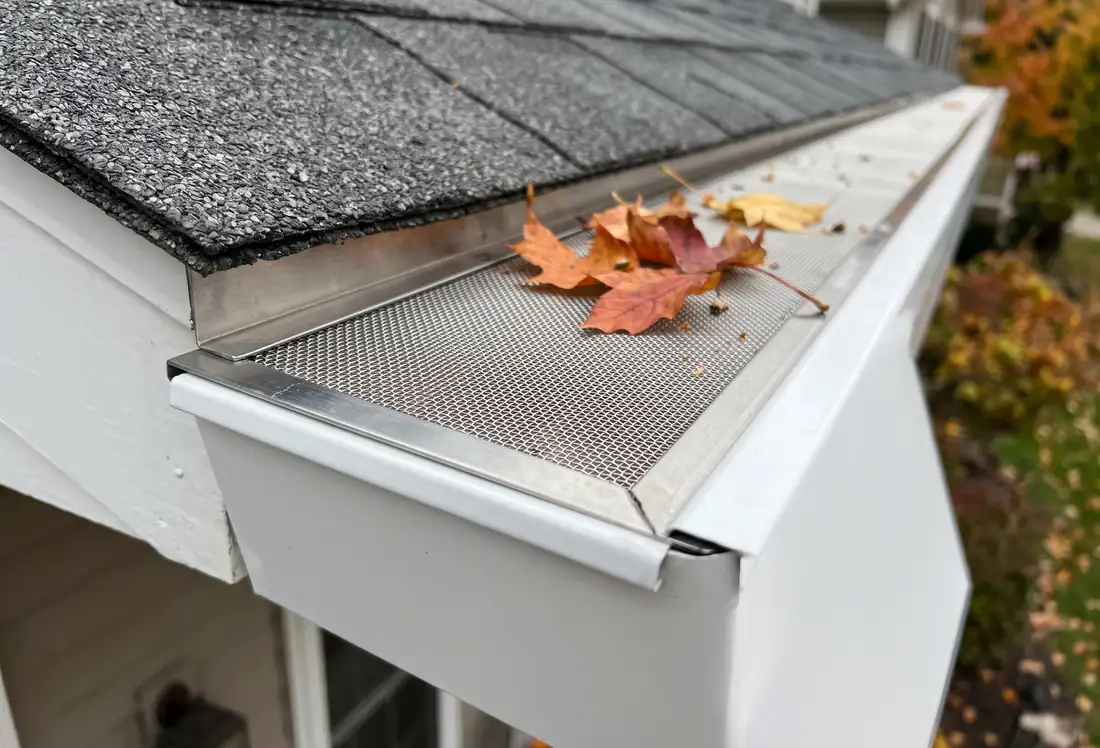
For a roof under firs, a stainless micro-mesh on a rigid frame is the usual recommendation. Under broad-leaf trees with little conifer, a perforated cover is often enough and costs less.
When guards are poor value
- No trees near the roof. Grit alone does not justify the cost.
- Gutters that need replacing soon. Fit guards with the new gutters instead.
- A roof thick with moss. Deal with the moss first, or the guard becomes a shelf for it.
- Easy single-story access. A cleaning once or twice a year may cost less over ten years than guards. The guide are gutter guards worth it? runs through the sums.
Fitting them properly
- The gutter is cleaned, flushed and checked for pitch first.
- The guard is fixed to the gutter lip and sits under the shingle edge or fastens to the fascia, following the manufacturer's method. Lifting or nailing through shingles can affect a roof warranty, so ask how it attaches.
- The surface should slope toward the lip so debris slides off, not lie flat.
- Valleys get a diverter or a different treatment.
- Corners are cut and fitted, not left open.
Questions to ask
- Which guard are you proposing, and how does it handle fir needles?
- How does it attach, and does that touch the shingles?
- What happens at the roof valleys?
- How is the guard cleaned, and can sections be lifted off to flush the gutter?
- Who provides the warranty, the manufacturer or you, and what does it cover?
- Will you clean and repair the gutters before fitting?
What types of gutter guard are there?
Five families cover nearly everything sold.
| Type | Also called | How it works |
|---|---|---|
| Micro-mesh | Fine mesh, stainless mesh | A woven screen with very small openings on a frame; water passes, debris stays on top |
| Perforated cover | Aluminum cover, punched cover | A metal sheet with small round holes across the gutter top |
| Screen | Wire or plastic mesh, drop-in screen | Coarse mesh laid in or clipped to the gutter |
| Reverse-curve | Surface-tension, hood, helmet | A solid cover whose rounded nose leads water into a slot while leaves fall off |
| Insert | Foam, brush | A porous foam wedge or bottle-brush that fills the trough |
Which gutter guard is best for Vancouver, WA?
For most houses under Douglas fir, western red cedar or pine, micro-mesh. The county's commonest debris is conifer needle, and micro-mesh is the only common type with openings smaller than a needle. Under bigleaf maple, alder or oak with few conifers nearby, a perforated aluminum cover does the job for less. Foam and brush inserts hold moisture and debris and tend to grow moss in this climate.
How are gutter guards installed?
- The gutters are cleaned and flushed, and any leak, sag or pitch problem is repaired.
- The guard's front edge is screwed or clipped to the gutter lip.
- The back edge tucks under the first shingle course or fastens to the fascia or the gutter's rear flange, depending on the product.
- Inside and outside corners are cut to fit.
- Roof valleys get a diverter or a section treated differently.
- End gaps are closed against birds, wasps and debris.
How do you maintain gutter guards?
- Brush or blow debris off the top after the fall needle drop and again in spring
- Rinse fine mesh when water starts to sheet across it
- Clear moss before it roots on shaded runs
- Lift a section every few years to check the trough and outlets
- Check after ice storms for sagging or dislodged panels
Guard types in detail
Related: gutter cleaning and the guide to moss, needles and gutters.