
On this page
- Where gutters leak
- Why joints fail here
- How a leak is fixed properly
- The leak that is not a leak
- Repair or replace
- Where exactly do gutters leak?
- How do you find a gutter leak?
- Can a leaking gutter damage a house?
- How do you seal a leaking gutter corner?
- When should a leaking gutter be replaced instead?
- What affects the price
Where gutters leak
A modern seamless gutter has no joints along its length. That narrows the search.
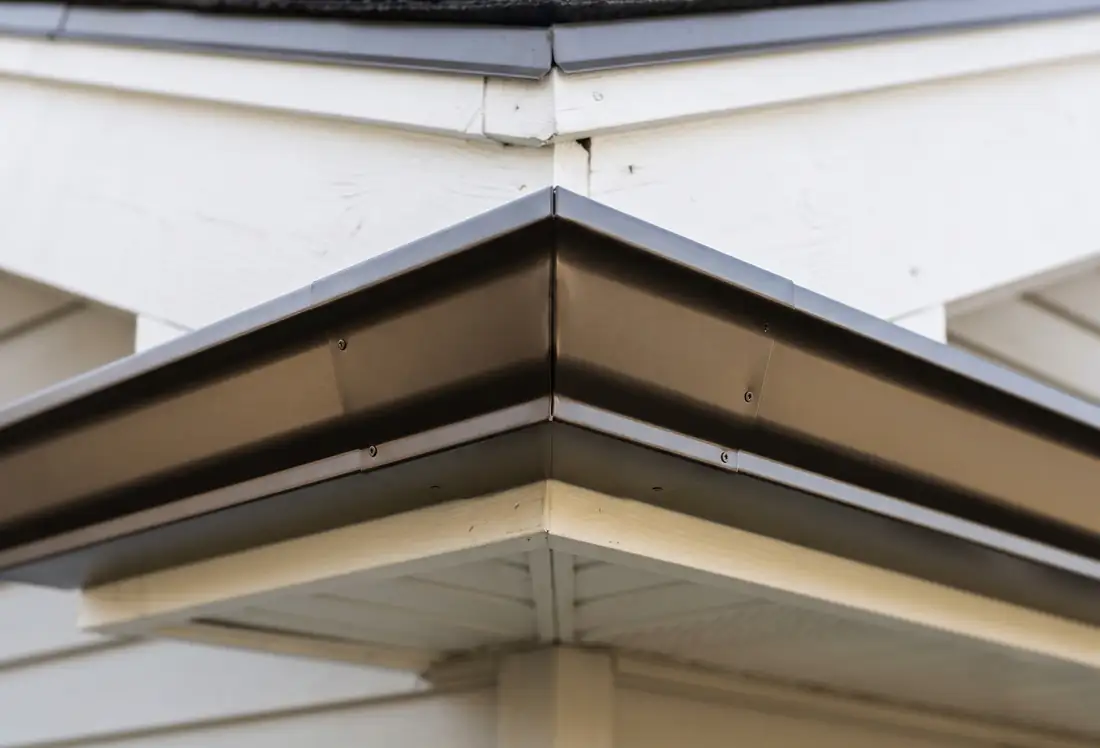
- Corners. Inside and outside miters, where two runs meet. The commonest leak of all.
- End caps. The plate closing the end of a run.
- Outlets. The fitting where the downspout leaves the gutter.
- Section joints on older sectional gutter, every ten feet or so.
- Holes. Old spike holes, punctures, and rust-through on steel.
- Behind the gutter. Water that never got into it.
Why joints fail here
Gutter sealant is flexible when new. It hardens with age, and the joint it bridges moves every day as the metal warms and cools. Vancouver adds a second stress: with measurable precipitation on about 161 days a year, a low corner can sit under water for most of the wet season, then bake dry in summer. Sealant that is wet for months and then shrinks in the sun cracks along the edges.
Debris speeds it up. Needles and grit collect at corners, hold water there, and keep the joint wet even between showers.
How a leak is fixed properly
- Find it. Run a hose in the gutter and watch from below. A leak often shows a foot or more from where the water is escaping.
- Clean the joint. Scrape out all the old sealant and debris, down to metal.
- Dry it. Completely.
- Check the fasteners. Tighten or replace the rivets or screws holding the corner together.
- Reseal from the inside with a sealant made for gutters, worked into the seam and smoothed.
- Check the pitch. If water was standing at the joint, correct the fall so it drains. See sagging gutters.
- Test once the sealant has cured.
Holes are patched from inside with a piece of matching metal bedded in sealant. Tape and roofing tar are temporary at best.
The leak that is not a leak
If the fascia is wet along its whole length and there are streaks down the back of the gutter, the water is coming off the roof edge and running behind. Either the shingles stop short of the gutter or the metal drip edge is missing. Sealing joints will change nothing. The repair is a strip of flashing slipped under the first course of shingles so that water is carried into the trough. Left alone, this is the leak that rots the board. See fascia and soffit.
Repair or replace
| Situation | Sensible course |
|---|---|
| One or two leaking corners on sound gutter | Reseal |
| Leaks at most joints of a sectional gutter | Replace with seamless |
| Leak at a joint that has been resealed several times | Remake the corner with a new miter |
| Pinholes or pitting along the trough floor | Replace the run |
| Rust-through on old steel | Replace the run |
Aluminum that is straight and unpitted is worth repairing. Where every joint of an old sectional system needs attention, the labor soon approaches the cost of replacement.
Where exactly do gutters leak?
| Location | Why it leaks |
|---|---|
| Inside or outside miter | Sealant hardened; rivets loose |
| End cap | Crimp loosened; sealant cracked |
| Outlet | Seal around the drop failed |
| Sectional joint | Slip connector sealant aged |
| Old spike hole | Hole enlarged or left open after re-hanging |
| Trough floor | Pitting under debris; rust on steel |
| Behind the gutter | No drip edge or gutter apron |
How do you find a gutter leak?
Wait for a dry day, run a garden hose into the high end, and watch the underside from the ground or a ladder. Mark each drip. Water can travel along the gutter's bottom before dropping, so the source is often uphill of the drip.
Can a leaking gutter damage a house?
Yes, slowly. A steady drip onto the same spot wets the fascia and soffit, stains siding, washes out soil at the foundation and splashes dirt onto walls. In a wet season lasting months, the affected wood never dries.
How do you seal a leaking gutter corner?
- Pick a dry day.
- Scrape out old sealant and debris with a putty knife and wire brush.
- Wipe the metal clean and let it dry completely.
- Tighten or replace loose rivets or screws at the miter.
- Apply gutter sealant along the inside of the seam and over fastener heads.
- Smooth it into the joint.
- Let it cure as the label directs before running water.
When should a leaking gutter be replaced instead?
When leaks appear at most joints of a sectional system, when the trough floor is pitted or rusted through, or when a corner has been resealed repeatedly and is torn. At that point new seamless gutter costs less over time than further patching.
What affects the price
- How many joints need work
- Height and access
- Whether the run has to be re-pitched
- Whether corners need remaking or only resealing
- Whether the leak has already damaged the fascia
Ask the contractor whether the price includes removing old sealant, and whether they will hose-test afterward.